Commercial Pest Control Compliance: HACCP, Audits & Irish Food-Safety Rules
Pest control is not merely a service that food businesses and hospitality operators buy when they have a problem. In Ireland, documented pest management is a legal requirement under European and national food safety legislation. This page sets out what the law requires, what an inspector expects to see, and what documentation a professional pest control contractor must provide.


Irish Regulatory Framework for Pest Control in Food Businesses
| Legislation / Standard | Administering Body | Pest Control Requirement |
|---|---|---|
| EC Regulation 852/2004 (Food Hygiene) | European Commission / FSAI | Food businesses must implement HACCP-based hygiene procedures. Pest management is a prerequisite programme under HACCP. Documented evidence required. |
| S.I. 369/2006 (European Communities Food Hygiene) | Department of Agriculture, Food and Marine | Implements EC 852/2004 in Irish law. Food business operators must comply. DAFM authorised officers carry out official controls. |
| Food Safety Authority of Ireland Act 1998 | FSAI | Establishes the FSAI and its powers. EHOs operating under service contracts enforce food safety legislation in food businesses. |
| Health Act 1947 (as amended) | HSE / Local Authorities | Environmental Health Officers may investigate premises where conditions constitute a public health risk, including pest infestations. |
| BRC Global Standard for Food Safety (Issue 9) | British Retail Consortium | Section 4.13 Pest Control requires documented pest management programmes, monitoring records, technician competency evidence. Required for BRC-certified suppliers. |
| HIQA National Standards (Healthcare) | Health Information and Quality Authority | Nursing homes and healthcare facilities assessed against hygiene and infection control standards. Pest management records reviewed during inspection. |
What Is HACCP and Why Does Pest Control Fall Under It?
HACCP (Hazard Analysis and Critical Control Points) is the food safety management system required of all food businesses in Ireland under EC Regulation 852/2004. It requires food operators to identify hazards, assess risks, and put controls in place to prevent food safety failures.
Pest management is classified as a HACCP prerequisite programme (PRP), a foundational hygiene control that must be in place before the main HACCP system can function. PRPs include personal hygiene, cleaning and disinfection, waste management, and pest control. Without adequate pest control documentation, your HACCP system is structurally incomplete.
The three core requirements of a HACCP-compliant pest control programme are:
- 1 Prevention: physical and structural measures to prevent pest entry and harbourage, proofing, waste management, maintenance.
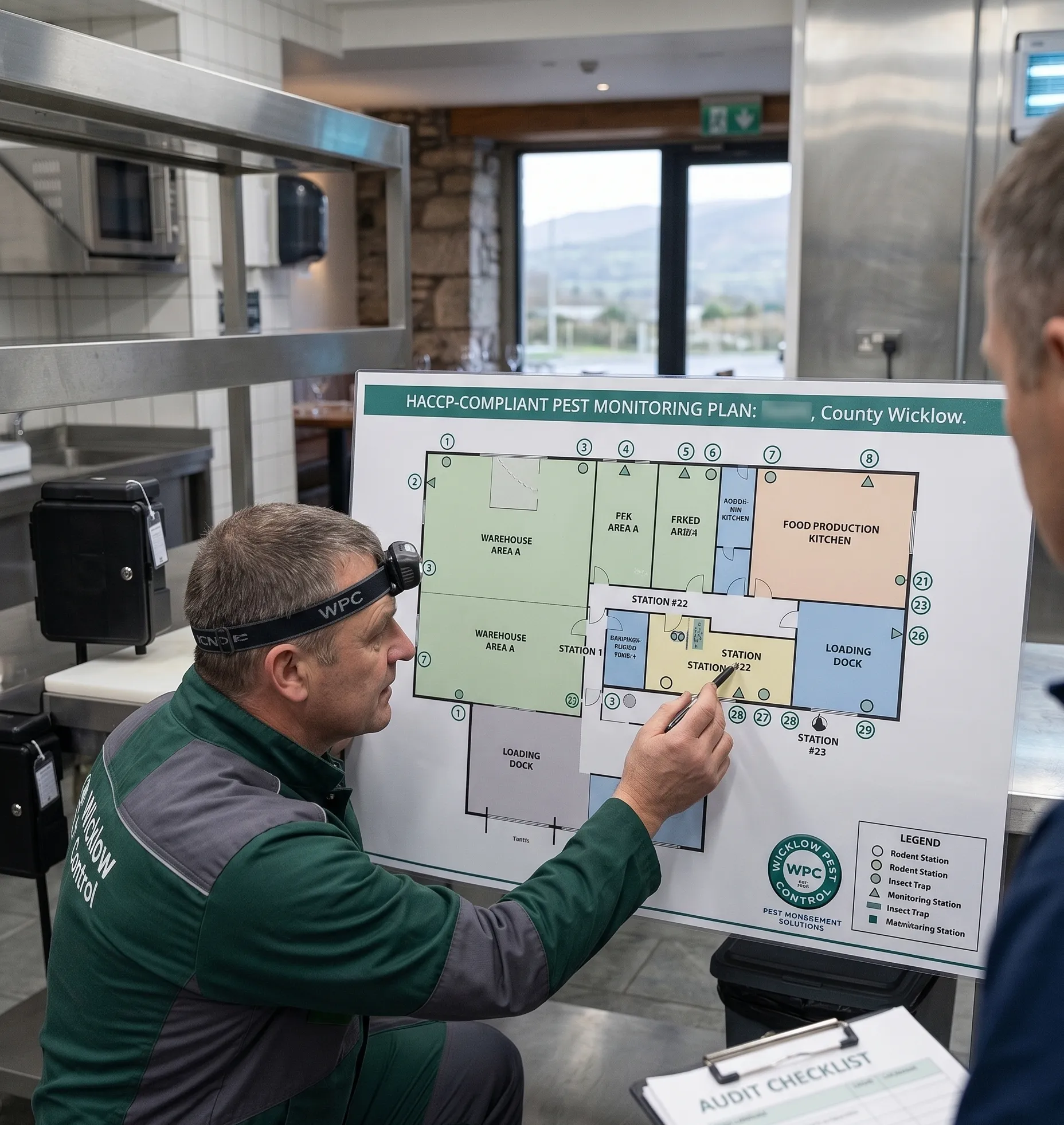
- 2 Monitoring: regular inspection and monitoring of pest activity using numbered stations, with findings recorded.
- 3 Response: documented treatment procedures when pest activity is detected, with corrective action records.
What the EHO Expects to See
When an Environmental Health Officer inspects a food business, they will assess pest management under the HACCP prerequisite section of their inspection form. Below is a summary of what inspectors typically examine:
| EHO Inspection Item | Compliant / Non-Compliant | Notes |
|---|---|---|
| Pest control contractor documentation on site | Must be present and current | Contract must be with a reputable, certified provider |
| Evidence of technician certification (PMU or equivalent) | Required | PMU (Pest Management Units) certification or equivalent professional qualification |
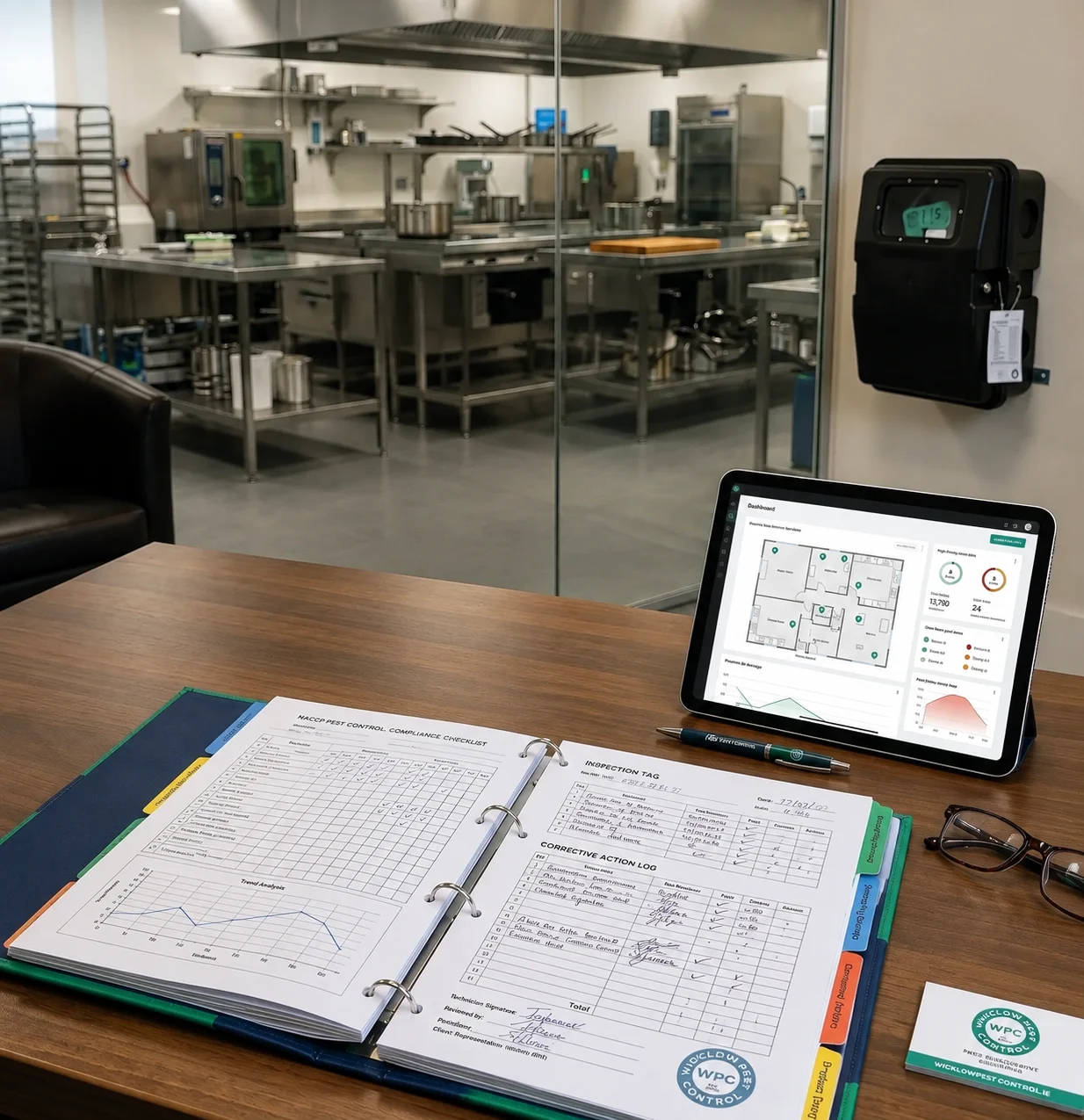
| Site survey report | Required | Dated, signed, identifying risk areas and monitoring station locations |
| Monitoring station map/site plan | Required | Numbered stations, current locations, must match physical placement on site |
| Signed treatment records with product information | Required | Product name, active ingredient, application method, quantity, operator ID |
| Product SDS (Safety Data Sheets) | Required | For all products used on site, must be current |
| Evidence of proofing and structural measures | Required | Written proofing recommendations and evidence of corrective action taken |
| No evidence of active pest activity | Required | Droppings, gnaw marks, live/dead pests, all constitute non-compliance |
The Three C's of Pest Control
'The 3 C's of pest control' is a mnemonic commonly referenced in food safety training and appears in Google's People Also Ask results for pest control compliance queries. The three C's are:
- 1 Cleanliness: removing food, water, and shelter that attracts and sustains pests. This includes waste management, clean drains, tidy storage, and removal of clutter that provides harbourage.
- 2 Clutter-free: reducing the areas where pests can hide, nest, and breed. Stacked materials, unused equipment, and inaccessible areas are prime harbourage sites.
- 3 Closing entry points: proofing the building to prevent pest ingress, gaps under doors (mice enter through 6mm gaps), holes around pipes, damaged brickwork, uncapped drainage.
In practice, Professional Pest Control programme addresses all three C's: treatment alone is insufficient if the structural and housekeeping conditions that support pest activity are not addressed. Wicklow Pest Control provides written proofing recommendations as part of every commercial survey.
Proofing (also called exclusion) is the most cost-effective control measure of all, because it stops pests getting in rather than dealing with them once they have. During a commercial survey we check the points pests exploit most often: gaps around incoming pipes and cables, worn or missing door seals, damaged air bricks and vents, open drainage and gully traps, and gaps at the roofline and eaves.
Each issue is set out in writing with a clear priority and a suggested timeframe, so the works can be planned and closed out. That written record also does double duty at audit: it shows an environmental health officer or food-safety auditor that risks on site are being actively managed and resolved, not just monitored.
Documentation Checklist - What Your Pest Control File Must Contain
| Document | Requirement / Notes |
|---|---|
| Pest management contract | Signed, current, with scope of services specified |
| Initial site survey report | Dated, signed by technician, identifying pest risks and monitoring station locations |
| Monitoring station site plan | Scaled plan with numbered station positions, must reflect current physical layout |
| Technician certification evidence | PMU certificate or equivalent qualification for all visiting technicians |
| Visit records / treatment logs | Signed per visit: date, time, findings, treatments applied, products, quantities, technician ID |
| Product SDS sheets | Current Safety Data Sheets for all products applied on site |
| Proofing recommendations | Written recommendations and dated corrective action records |
| Corrective action log | Record of any pest activity found and action taken to resolve it |
| Annual trend analysis / review | Recommended: annual summary of monitoring data, pest pressure trends, programme adjustments |
Frequently Asked Questions
Commercial Pest Control Compliance
Wicklow Pest Control provides written proofing recommendations as part of every commercial survey.