Mice Control Wicklow & Professional Mouse Removal
Wicklow Pest Control provides professional mice control and rodent control services across Co. Wicklow and Leinster, including treatment, trapping, proofing and follow-up support. PMU-certified technicians, guaranteed treatment programme, 24-hour call-out.
Treatment is competitively priced for residential properties, with the final cost shaped by property size and infestation severity. Commercial contracts available.

Mice are the most commonly reported pest in Irish homes and food businesses. The house mouse (Mus musculus) is a prolific breeder - a single female can produce 5-10 litters of 3-14 pups per year. An infestation can establish and grow rapidly, particularly in autumn and winter when falling temperatures drive mice indoors in search of food, warmth, and nesting material.
Wicklow Pest Control has provided professional mice removal services across Co. Wicklow and Leinster for 36 years. Our PMU-certified technicians use a structured treatment programme combining baiting, trapping, and proofing - addressing the infestation and preventing re-entry.
Signs of a Mouse Infestation
| Sign | What It Looks Like |
|---|---|
| Droppings | Dark, 3-6mm, spindle-shaped. Found along runs, in cupboards, behind appliances, in loft spaces. Fresh droppings are moist and dark; older droppings are dry and grey. |
| Gnaw marks | Mice gnaw continuously to keep their incisors at working length. Gnaw marks on food packaging, furniture, cables, pipework, and skirting boards. Fresh marks are pale and sharp-edged. |
| Grease runs/smear marks | Oily marks along walls and baseboards where mice run repeatedly - their fur deposits grease from their bodies. Most obvious on pale surfaces near entry points. |
| Nesting material | Shredded insulation, paper, cardboard, fabric. Found in loft spaces, under kitchen units, inside cavity walls, behind fridges. |
| Scratching/movement sounds | Scratching, scurrying, and squeaking - particularly at night when mice are most active. Most audible in ceiling voids and wall cavities. |
| Ammonia smell | Concentrated mouse urine has a strong ammonia odour. In confined spaces with heavy infestation (loft, under units), the smell can be significant. |
| Live or dead mice | Seeing a mouse during the day suggests a significant infestation - mice are naturally nocturnal and daytime activity indicates population pressure. |
Professional Mice Control in Wicklow
Step 1: Survey
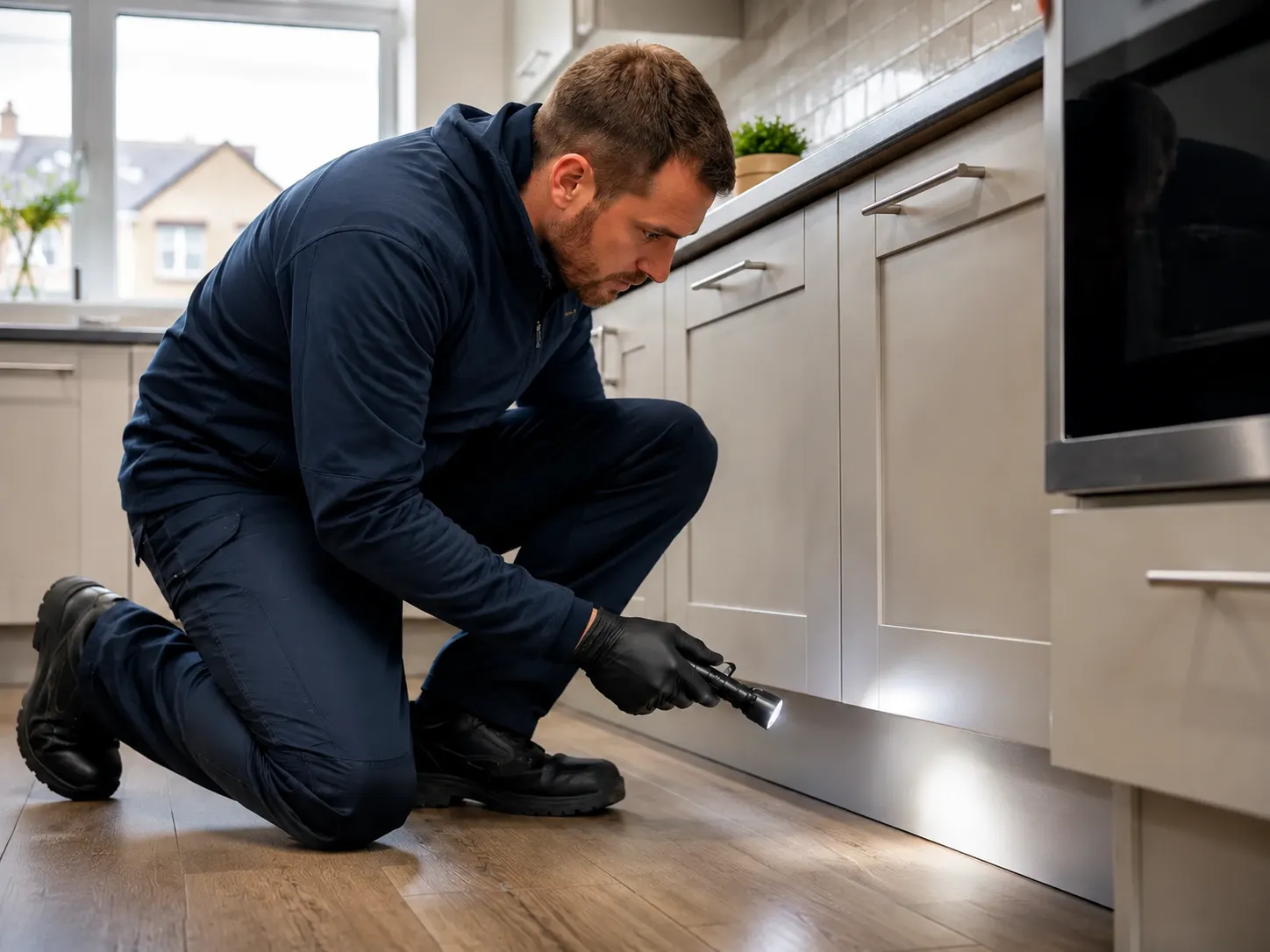
Our professional mice and rodent control service includes inspection, treatment, proofing and follow-up to prevent re-entry. A PMU-certified technician inspects the property to identify: the extent of the infestation, entry points (mice can enter through gaps of 6mm - the width of a pencil), harbourage areas, and food/water sources. A written survey report is provided.
Step 2: Baiting Programme
Tamper-resistant bait stations are placed at identified mouse runs and activity areas. Stations are numbered, located close to walls (mice travel along wall lines), and checked at each follow-up visit. Professional-grade rodenticides approved for use in Ireland are used in accordance with product label requirements and Irish Pest Control Association (IPCA) guidance.
Step 3: Trapping (where appropriate)
In situations where baiting alone is not appropriate - for example, in kitchens of food businesses where bait products cannot be used, or in properties where secondary poisoning risk to pets or non-target wildlife is a concern - snap trapping provides an effective alternative or complement to baiting.
Step 4: Proofing
Treatment without proofing provides only temporary relief. Our technicians identify all entry points and provide written proofing recommendations. Proofing work (gap sealing, door brush strips, pipe surround sealing, mesh installation) can be carried out by Wicklow Pest Control or arranged by the property owner.
- Mice enter through gaps of 6mm (the width of a pencil or 5c coin)
- Common entry points: gaps around pipes and cables, under external doors, through air bricks, via roof spaces, through damaged brickwork
- Standard mouse-proofing materials: steel wool packed into gaps, metal kick plates under doors, expanding foam (secondary barrier only - mice can gnaw through foam alone)
Step 5: Follow-Up Visits
Mice treatment requires follow-up visits to check bait take, replenish bait, and monitor for continued activity. A standard residential mice treatment programme typically involves 2-3 visits over 3-4 weeks. A completion certificate is issued when no further activity is detected.
Mice Treatment Costs in Ireland
Wicklow Pest Control prices its services for the Irish market. The following gives a general sense of what to expect for standard residential treatments in Co. Wicklow and Leinster:
| Treatment Type | Price Guide (ex-VAT) | Notes |
|---|---|---|
| Residential mice treatment (survey + 2 follow-ups) | Competitively priced, scaled to property size | Standard 3-visit programme. Price varies with property size. |
| Additional visits (if required) | Modest per-visit charge | Charged if infestation requires more than standard programme. |
| Proofing works (labour only, materials extra) - to be agreed | Affordable, scope-dependent | Depends on number of entry points and access. |
| Commercial mice contract (monthly monitoring) | Cost-effective monthly rate | Includes HACCP documentation and priority call-out. |
Disclaimer: Pricing may vary depending on the time of year and weather conditions. Emergency calls may differ due to holidays, bank holidays and in-house training. Contact Wicklow Pest Control for a written quotation.
Mice and Rodent Treatment
The house mouse is a disease vector. Key health risks associated with mouse infestations:
- Salmonellosis: Salmonella bacteria are shed in mouse droppings and urine and can contaminate food preparation surfaces, utensils, and food itself.
- Leptospirosis: caused by Leptospira bacteria carried in rodent urine. Less common in mice than rats but present.
- Hantavirus: shed in mouse droppings, urine, and saliva. Inhalation of dried particles is the primary transmission route. Rare in Ireland but a reason for protective equipment when cleaning up after mice.
- Lymphocytic choriomeningitis (LCM): carried by house mice. Human infection typically via contact with fresh mouse urine, droppings, saliva, or nesting material.
- Allergens: mouse urine contains proteins that are potent allergens - a significant concern in properties with asthma sufferers, particularly children.
- Property damage: mice gnaw electrical cables, creating a fire risk. A significant proportion of unexplained electrical fires are attributable to rodent gnaw damage.
Service Areas - Mice Control Wicklow
- Bray, Greystones, Wicklow Town, Arklownorth to south coast
- Enniskerry, Newtownmountkennedy, Kilcoole, Newcastleinland north Wicklow
- Rathdrum, Avoca, Tinahely, Shillelaghsouth and west Wicklow
- Citywest, Tallaght, South Dublinborder areas covered
- Full Leinster coveragecontact us for areas outside listed locations
Frequently Asked Questions
-
How much does it cost to get rid of mice in Ireland?
Professional mice treatment in Ireland is competitively priced for a standard residential property (3-visit programme). This is separate from UK price comparison sites, which quote in GBP - those figures do not apply to Ireland. Cost varies with property size, severity of infestation, and number of follow-up visits required. Contact Wicklow Pest Control for a written quotation. -
How long does mice treatment take to work?
A professional baiting programme typically shows results within 5-10 days of the first visit. Bait take at monitoring stations confirms active feeding. The full treatment programme - survey plus 2-3 follow-up visits - is normally completed within 3-4 weeks. The property is declared clear when no fresh activity is detected at any monitoring station. -
Can I get rid of mice myself?
DIY mice control using supermarket snap traps or bait products can reduce mouse numbers but rarely eliminates an established infestation. The key limitations are: insufficient bait station coverage; inability to access all harbourage and run areas; lack of proofing to prevent re-entry; and the continued use of DIY products that mice may become bait-shy to over time. For a property with an established infestation - more than occasional sightings - professional treatment is significantly more effective and more economical in the long run. -
Do mice come back after treatment?
Mice return if entry points are not sealed after treatment. Baiting kills the current population but does not prevent new mice from entering. The proofing stage of a professional treatment programme is essential to long-term results. Wicklow Pest Control provides written proofing recommendations with every treatment.
Professional Mice Removal - Co. Wicklow
Wicklow Pest Control provides professional mice treatment and proofing services across Co. Wicklow and Leinster. PMU-certified technicians, guaranteed treatment programme, 24-hour call-out.